
The Fast and Slow of Justice
LETTER BY GRACE POUCH
Right out of the starting gate, after resisting the devil’s temptations in the wilderness, Jesus begins demolishing the devil’s strongholds in the world.
At his first public speaking engagement, Jesus goes to the synagogue and picks up Isaiah’s scroll.
The Spirit of the Lord is on me,
because he has anointed me
to proclaim good news to the poor.
He has sent me to proclaim freedom for the prisoners
and recovery of sight for the blind,
to set the oppressed free,
to proclaim the year of the Lord’s favor.
This is Jesus’ emancipation proclamation. God’s kingdom is at hand! And he will break the power of every form of bondage — spiritual, mental, economic, physical, self-induced or other-imposed. Freedom is here!
The passage rings with urgency. Sometimes spiritual formation depends on slowing down. And sometimes becoming like Jesus means imitating his promptness. Discernment is knowing when to be slow and when to be swift.
Jesus urges slowness when his followers are hot headed, impatient for results, and driven by ambition rather than love. He lived and taught a way of unhurried listening and thoughtful attention to the natural world. He observed Sabbath — a day of slowness and rest designed to release people from the bondage of frantic productivity (which often drives dehumanizing practices like slavery).
But when it comes to trusting and obeying God and doing justice, Jesus is the definition of promptness and even speed. He warns his listeners not to delay their discipleship. He chides them for being “slow to believe the prophets.” He confronts the tendency in us all to be quick to cast stones at others but slow to acknowledge our own sin. He was swift to recognize hypocrisy and to set captives free.
On the fringes of the American frontier in 1865, news of Abraham Lincoln’s Emancipation Proclamation was slow to arrive. Freedom had been a reality for two years, but in that region (and many others) the false authority of a rogue government and the economic system of chattel slavery continued to reign. The day that freedom was proclaimed in Galveston, Texas — June 19, 1865, or Juneteenth — is commemorated as a day of rejoicing, but it’s also a painful reminder that “Justice delayed is justice denied.”
There is no virtue in being slow to love or slow to do justice.
“Today,” Jesus said, “right now this scripture is fulfilled in your hearing” (Luke 4:21).
Is this true for us?
Will we be swift to proclaim the Kingdom of God today?
Will we offer timely warnings about things that deform and deceive?
Will we confront systems and practices that bind people in various forms of slavery and rob them of God-given abilities?
If we can’t be bothered to look beneath the surface of our comfortable lives, or if we consider forms of oppression impossible to resist — and yet we claim to be his people — we misrepresent Christ.
But when the people of God are timely heralds of good news and swift to resist injustice, Jesus Christ is lifted up. It might be the most evangelical thing we can do: to bring good news to the poor… to proclaim release to the captives and recovery of sight to the blind, to set free those who are oppressed.

Grace Pouch
Content Manager

Sign up for Renovaré Weekly
Thoughtfully introduced Christ-centered spiritual formation resources.

LET’S DIVE IN...
CURATED BY GRACE POUCH
-
1.
At Renovaré’s Ministry Team retreat this week, Lacy Borgo recommended the PBS documentary Becoming Frederick Douglass as a powerful testimony of God’s justice breaking into human history.
-
2.
John Woolman could be considered ahead of his time since he was an abolitionist in the 1770s, but his promptness came from being well-attuned to the Spirit and ready to do God’s will without delay. Read “Walking as He Walked.”
-
3.
In Magnificent Humanity, Pope Leo XIV gives an apology on behalf of the Catholic Church for being too slow to officially condemn slavery in the past, and pairs it with a call to discern and respond in the present to exploitative practices that are “directly linked to the digital economy.” Read “Safeguarding Humanity: Breaking the Chains of New Forms of Slavery.”
-
4.
This article from IVP is packed with practical ideas and resources for celebrating Juneteenth and engaging in God’s ongoing story of freedom.
WORTH QUOTING
The living God descends into our history in order to free us from all forms of slavery.
– Pope Leo XIV (source)
TO CONTEMPLATE
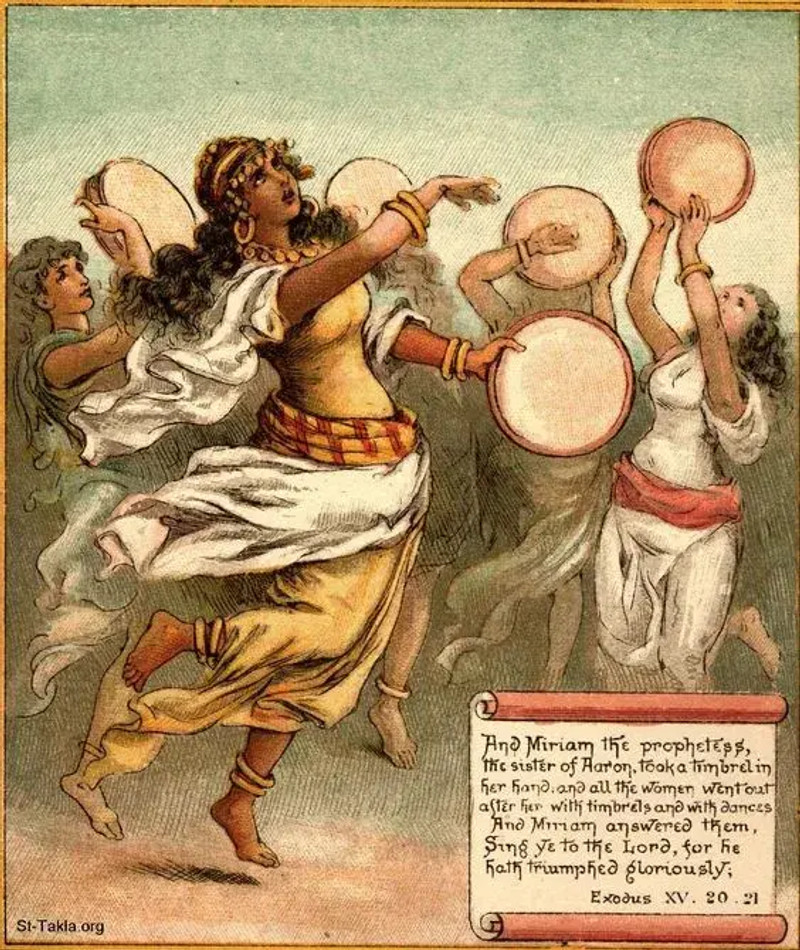
from The Coloured Picture Bible for Children
1900
When God sets free, it’s right to celebrate. After the escape from Egypt, the whole community gathered to sing and dance, and Moses’ sister Miriam, “took a timbrel in her hand, and all the women followed her, with timbrels and dancing.”
TO PONDER
From Israel’s song of celebration in Exodus 15:
Who among the gods is like you, Lord?
Who is like you — majestic in holiness,
awesome in glory, working wonders?
In your unfailing love
you will lead the people you have redeemed.
In your strength you will guide them
to your holy dwelling.
You will bring them in and plant them
on the mountain of your inheritance—
the place, Lord, you made for your dwelling,
the sanctuary, Lord, your hands established.
The Lord reigns for ever and ever.