

Introductory Note
“The living God descends into our history in order to free us from all forms of slavery,” writes Pope Leo XIV in his 2026 Encyclical, Magnifica Humanitas: Safeguarding the Human Person in the Time of Artificial Intelligence.
The full Encyclical is a must read. But the following excerpt comes from Chapter 4 where Pope Leo specifically addresses the need to protect the dignity and freedom people in a time where technological innovation is often “built on a chain of exploitation that remains deliberately hidden.”
In paragraphs 176 – 178, Leo apologizes for the Catholic Church being slow to condemn slavery in the past — “a wound in Christian memory, one from which we cannot consider ourselves detached.” He then says we must translate what we have learned into the present by discerning and resisting exploitative practices that are “directly linked to the digital economy.”
This Encyclical’s wisdom is the fruit of an ecumenical group process marked by listening widely, discerning in community, and trusting the spiritual gifts distributed among the Body. Addressed “to all the Catholic faithful, to all Christians and to men and women of goodwill,” the document has already been a remarkable tool for evangelism, drawing men and women to Christ by responding to their present needs with love and wisdom. I believe it will be a guiding light for hundreds of years to come.
Grace Pouch, Content Manager
Dependencies and societal control
170. …We must now consider the impact of the digital revolution on human freedom, addressing risks to both the mental health of individuals and broader social challenges. The subtler forms of addiction linked to the “digital attention economy” should not be underestimated, since platforms and services are often designed to capture users’ time and attention, exploiting their vulnerabilities and weakening their inner freedom. When business models thrive on human weakness, the person is treated as a means rather than as an end; those who design or finance such systems bear a moral responsibility that cannot be ignored. There is an urgent need to promote technologies that strengthen interior freedom by fostering education in digital sobriety and the protection of minors, thus countering models that exploit vulnerability.
171. A further risk, less visible but no less serious, is that of social control made possible by the massive collection of data and use of algorithmic systems. When every action — movements, purchases, relationships and preferences — leaves a trace, a new form of power emerges, namely the power to profile, predict and influence behavior, often without individuals being fully aware of it. If such kinds of data are used to make decisions affecting concrete opportunities — such as access to credit, employment or essential services — there is a risk of undermining freedom and discriminating against the most vulnerable. Furthermore, control is exercised not only through explicit prohibitions, but also through the architecture of visibility: what is amplified or rendered invisible, what is rewarded or penalized, ultimately shapes opinions and choices, fostering conformity and self-censorship. For this reason, freedom in the digital age is not merely a matter of interiority but also a public concern. It calls for clear rules, transparency, the possibility of recourse and proportionate limits on the use of intrusive technologies, so that technology will remain at the service of the human person and not become a form of control over consciences.
172. At the root of these problems lies a technocratic and post-humanist mentality that tends to regard the human person as an object to be manipulated or a resource to be optimized, [172] removing all safeguards against the unchecked pursuit of profit. What prevails is efficiency, rather than respect for freedom and human dignity. Some post-humanist currents even go so far as to envision “second-class” human beings, subordinate to the interests of elites who consider themselves superior. This troubling prospect becomes all the more serious when combined with technological tools that exponentially increase the capacity for control and selection. Even certain forms of structural indebtedness, which keep entire peoples in conditions of dependence, reflect the same mentality, in new forms, that tolerates relationships of subordination akin to slavery.
Breaking the chains of new forms of slavery
173. This distorted view of the human person is reflected today in various forms of servitude directly linked to the digital economy. Nothing in the world of AI is immaterial or magical. Every seemingly immediate and flawless response is the result of a long chain of mediation, involving vast networks of natural resources, energy infrastructure and, above all, people. A significant part of the digital economy’s functioning relies on the silent work of millions of people engaged in essential yet largely unseen activities, such as data labeling, model training and content moderation, often involving disturbing material. In many cases, these workers are young people, predominantly women, working under demanding conditions for minimal wages. Added to this invisible labor is the even harsher work of extracting the resources required for the production of the devices and microprocessors on which AI depends. In some regions of the world, children and adolescents work in dangerous conditions, crushing the materials from which rare earth elements are extracted. The bodies of these people are scarred, injured and worn down so that computational flow may continue uninterruptedly. Furthermore, criminal networks use online platforms, messaging systems, anonymous payment methods and profiling techniques in order to recruit, control and transport victims of trafficking — very often minors — reducing men and women to “data” to be tracked and “packages” to be moved around within the same digital circuits that support much of the global economy. This reality deeply challenges the moral conscience of our time. It is not enough to invoke efficiency, nor to celebrate the benefits of innovation, if they are built on a chain of exploitation that remains deliberately hidden. If technology promises emancipation, yet produces new forms of global subordination, it stands in contradiction to the fundamental principle of human dignity.
174. The fight against new forms of slavery is a decisive test for the ethical discernment of AI and digital transformation. In continuity with the tradition inaugurated by Leo XIII, the Church renews her firm condemnation of all forms of slavery, trafficking and the commodification of persons. She likewise highlights the urgent need for reflection and action that keep the inalienable dignity of every human being and the common good, as both the focus and goal of society, as well as the guiding criteria for every personal, social and political choice. Without this ethical and humanizing reflection, the growing power of digital systems could lead us toward new atrocities that are no less shameful than those of the past that we now deplore, while we continue to present ourselves as “advanced” and “civilized” societies.
175. Human trafficking must be recognized as a contemporary form of slavery and a grave violation of human dignity. Failing to respond firmly, or tolerating these practices in any way, is in some way to become complicit in today’s sins, which are akin to those of the past when slavery was being concealed and justified. [173]
176. In the development of her doctrine, the Church has gradually come to a deeper awareness of the gravity of these issues. It is true that past events cannot be judged anachronistically, as though the moral criteria that matured over time had always been available. Yet neither can we deny or diminish the delay with which both society and the Church came to denounce the scourge of slavery. In antiquity and the Middle Ages many individuals and even ecclesiastical institutions had slaves. Already in the early modern period, the Apostolic See of Rome, responding to requests from Sovereigns, intervened several times in order to regulate and legitimize forms of subjugation, and, in certain cases, the enslavement of “infidels.” [174] It was only in the nineteenth century that a formal, absolute and universal condemnation of slavery was clearly articulated, notably under Pope Leo XIII. [175] This development offers a clear example of the Church’s growth in understanding the perennial truths of Revelation that she safeguards. Although there was not always consistency in practice — given that slavery was long tolerated before being unequivocally condemned — there has been a continuous affirmation throughout history of the dignity of every human being, created in the image of God, even if it took eighteen centuries for its full incompatibility with slavery to be explicitly recognized. This constitutes a wound in Christian memory, one from which we cannot consider ourselves detached. [176] It is impossible not to feel deep sorrow when contemplating the immense suffering and humiliation endured by so many in stark contrast to their immeasurable dignity as persons infinitely loved by the Lord. For this, in the name of the Church, I sincerely ask for pardon.
177. This is why the memory of past complicity and blindness in the face of the injustice of slavery becomes a call to vigilance. What we have learned must be translated into discernment and responsibility in the present. If we want to avoid the need to ask for pardon again in the future for having failed to respect the treasure of human dignity that is required by our faith, it falls to us today to denounce, clearly and firmly, trafficking in its many forms and, together with all who are committed to this cause, to support concrete efforts of prevention, protection, liberation and rehabilitation.
178. Even today, colonialism assumes new forms. It no longer dominates only bodies, but appropriates data, transforming personal lives into exploitable information. Entire regions, especially those marked by structural fragility and limited geopolitical relevance, are currently subjected to a new mindset of extraction: that of health data, epidemiological profiles, genetic maps and demographic information. These have become the new “rare earths” of power: vital data which, once aggregated and analyzed, can be used to train predictive models, guide investment strategies, anticipate crises and, above all, determine who and what is deemed to matter. Those who control the health data of entire peoples — often collected under the pretext of aid, research or innovation — possess a structural leverage over the future, for they can shape needs and markets. They can also decide, before others, to whom medicines, investments and protections will be allocated. Here lies one of the most urgent moral challenges of our time: to ensure that shared knowledge becomes a true common good rather than an instrument of dominance. This requires restoring to individuals not only the data that describes them, but also the ability to decide how it is used, by whom and for whose benefit. Otherwise, the digital age will not be post-colonial, but colonial in another form.
179. New forms of slavery are fueled by economic chains and digital infrastructures. Therefore, action is required on several fronts. First, the supply chains that underpin the technological industry and the digital economy need to become more transparent, so that no competitive advantage is built upon hidden exploitation. Second, companies and investors need to adopt clear criteria for preventive ethical verification (due diligence), placing among their priorities the protection of workers, the fight against forced labor and the assessment of the social impact of data-driven business models. Furthermore, digital platforms must cooperate responsibly with authorities and civil society to prevent communication, payment and profiling tools from becoming channels for the recruitment and control of victims. When such efforts converge, the digital environment can be transformed from a space of exploitation into one of protection, prevention and the promotion of human dignity.
A shared responsibility
180. The various areas just considered— the search for the truth in public life, education in the digital environment, the transformation of work, the fragility of families and new forms of slavery — are not isolated phenomena. Rather, they reflect a common underlying issue, namely that if technology becomes the ultimate criterion, the human person risks being reduced to data, a cog in a machine or a commodity. If, however, technology is integrated with a wise perspective, it can become an instrument of growth, justice and fraternity.
181. From this perspective, the Social Doctrine of the Church calls for a shared responsibility. It asks that these processes be guided with foresight: by institutions capable of regulating without stifling, and protecting without taking over; by businesses that recognize work and dignity as measures of success; by intermediary organizations and educational communities that rebuild trust and relationships; and by citizens who cultivate responsibility, moderation, discernment and a sense of truth. Only in this way can innovation genuinely serve integral human development, rather than becoming a source of exclusion and dominance. And only in this way can the promise of progress be recognized as authentic, because it is measured against the inviolable dignity of every man and woman.
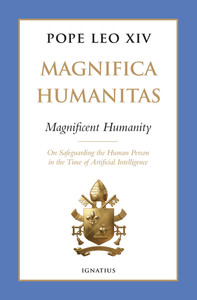
Taken from the Encyclical Letter Magnifica Humanitas: Safeguarding the Human Person in the Time of Artificial Intelligence by Pope Leo XIV.
Artwork: Solomon Raj Liberation Prints via artway.eu
First Published May 2026 · Last Featured on Renovare.org June 2026

Leo XIV
Pope Leo XIV, born Robert Francis Prevost, became the 267th Pope of the Roman Catholic Church following his election on May 8, 2025. He is the first Augustinian Pope and the second Pope from the Americas, after Pope Francis.

Get spiritual formation articles like this each Friday
Renovaré Weekly is our thoughtful free newsletter with curated articles, books, and upcoming free webinars.