Here is your starter kit of twelve resources. These I am listing in the order I suggest you read them, the first ones being the more accessible.
Obviously, the number twelve might cause you to think of this as a one-year reading/studying/experiencing program, one resource per month. And, yes, I did have that in mind. But you may prefer to go through them over two, three, or even four years. The key is to read slowly, bringing all you read into your own interior experience. It does us no good to read hurriedly about patience. No, we need to take our time until patience works its way deep into the habit structures of our heart and mind and body.
I will do my best to unpack these twelve resources sufficiently so that you can see their value for us. Just like you and I today, people down through the centuries have sought to overcome soul-crushing evils and enter into life-giving virtues. We can learn from their wisdom, even from their mistakes and failures. My hope is that these twelve resources will give you a good exposure to this life that is Life indeed.
Before you dive in, I want to suggest two resources that have been developed by our Renovaré team that could stand as a kind of “CliffNotes” to the devotional classics.
The first is Devotional Classics, edited by James Bryan Smith and myself; the second is Spiritual Classics, edited by Emilie Griffin and myself. Both of these provide selected readings from the classics of devotion that will give you a brief taste of many of the writers discussed here, plus others. Devotional Classics provides selections that are well recognized from the canon of devotional literature. Spiritual Classics, on the other hand, focuses attention on great writers of devotion that are often underrepresented, most especially people of color and women. Enjoy.
 Richard J. Foster

As Laubach uses the term, “mystic” refers to someone who believes that communion with God is actually possible-that we can talk with God and that God can talk with us. Read, for example, his Learning the Vocabulary of God and you will see what a living, vital experience this was for Laubach.
Letters by a Modern Mystic grew out of the ashes of a bitter disappointment. Laubach had worked as an educator in the Philippines for ten years, and when a decision was made to set up a college in Manila he desperately wanted the new position of college president. However, out of chivalry he voted for his opponent… and lost the presidency by one vote. With his educational career in shambles, Laubach retreated to beautiful Lake Lanao on the island of Mindanao. Here he was to discover his life work as the “Apostle of Literacy” to the “silent billion,” those who could neither read nor write. To this day the Laubach literacy method is used around the world. I personally witnessed its use among inner-city children in Long Beach, CA.
Laubach wrote a whole host of books over his lifetime, but these letters written on Mindanao stand above them all. Here God taught him many lessons, and among the first was about his own racism toward the Moro people. God spoke into his heart: “If you want the Moros to be fair to your religion, be fair to theirs. Study their Koran with them.” The next day, Moros crowded into Laubach’s little cottage, “each with a Koran under his arm. They were bent upon making a Moslem out of me! So we went to work with great zeal.” Laubach notes, “After that night on Signal Hill, when God killed my racial prejudice and made me color-blind, it seemed as though He were working miracles at every turn.”
By far the greatest miracle of all was the deep, interior formation of Laubach himself. On October 7, 1930, he wrote, “You see, I feel deeply about us all. Beside Jesus, the whole lot of us are so contemptible. I do not see how God stomachs us at all. But God is like Jesus, and He will not give up until we, too, are like Jesus.”
These letters are crammed with his intimate interactions with God and the resulting formation of soul. Here is one of my favorite stories: “The day had been rich but strenuous, so I climbed ‘Signal Hill’ back of my house, talking and listening to God all the way up, all the way back, all the lovely half hour on the top. And God talked back! I let my tongue go loose and from it there flowed poetry far more beautiful than any I ever composed. It flowed without pausing and without ever a failing syllable for a half hour. I listened astonished and full of joy and gratitude. I wanted a Dictaphone for I knew that I should not be able to remember it — and now I cannot. ‘Why,’ someone may ask, ‘did God waste His poetry on you alone, when you could not carry it home?’ You will have to ask God that question. I only know He did and I am happy in the memory.” Stories like this are peppered throughout Letters by a Modern Mystic. I fell in love with the stories and the stories have helped me to fall in love with God all the more.

Distraction is the great burden we bear in our emailing, tweeting, texting world. It scatters our thinking and distracts our relationships-indeed, our whole lives. So Brother Lawrence’s counsel to walk constantly in the presence of God is not just a nice idea for a seventeenth-century monk but a welcome necessity today for our fragmented lives.
Brother Lawrence of the Resurrection worked in a monastery kitchen cleaning and cooking for his brother monks. And he developed a habit — a holy habit, if you will —of “a loving gaze upon God” even in the hassle of multiple kitchen duties. He witnesses that “the time of business does not with me differ from the time of prayer; and in the noise and clatter of my kitchen, while several persons are at the same time calling for different things, I possess God in as great tranquility as if I were upon my knees at the blessed sacrament.”
Now, if you are like me you became excited about the prospect of practicing the presence of God and so tried it for yourself… and then fell flat on your face! If so, rest easy. Brother Lawrence says it took him ten years before entering such tranquility of soul. Maybe we could use a little more practice.
I am not sure that “practice makes perfect,” but it certainly helps. Brother Lawrence writes, “I do nothing else but abide in his holy presence, and I do this by simple attentiveness and an habitual, loving turning of my eyes on him. This I should call … a wordless and secret conversation between the soul and God which no longer ends.”

If you know of Athanasius, it is likely from his pivotal book On the Incarnation. His teaching there became crystalized in the Nicene Creed, the critical phrases being that Jesus was “begotten not made” (in opposition to Arius’s position that Christ was created) and “of one substance with the Father” (in opposition to Nestorius’s position of the two distinct beings of Christ). So, we can thank God for Athanasius’s high Christology.
Here we focus on another of Athanasius’s writings, one that became something of a literary sensation in its day, The Life of Antony. Antony’s story had a profound impact upon Athanasius and he determined to introduce his amazing life to the watching world. Antony can be considered the Father of the Egyptian desert dwellers and his story is indeed a wonder and a marvel, especially his numerous encounters with demons.
He encountered so many, in fact, that he became know as a “warrior against demons.” Like me, you may be tempted (no pun intended — well, maybe a little) to dismiss such encounters out of hand. Before you do, however, note how subtle and psychologically suggestive they are. The stories deal with far more than conquering demons; more profoundly, they deal with the conquering of the self — the demons within. Throughout the stories are penetrating elements of self-scrutiny, self-knowledge, and self-mastery. Also, the stories carry with them the sense of growth in grace, of character formation, of clarifying the motives and intents of the heart.
They also carry a sense of askesis, the training in spiritual disciplines. There is solitude and fasting for the sake of intense, internal focus; meditation and prayer for the sake of deepening spiritual communion; Scripture study and reflection for the sake of transforming the mind; and manual labor for the sake of doing the works of the Father. After twenty years in the desert, Antony is catapulted into one of the most remarkable ministries of that day. Athanasius writes, “ALl rejoiced while Antony talked about these things. In some, the love of virtue increased, in others carelessness was discarded, and in still others conceit was brought to an end. And all were persuaded to hate the demonic conniving, marveling at the grace given by the Lord to Antony for the discernment of spirits.” Interestingly, toward the end of his life Antony returned to the solitude of the Egyptian desert, free from any compulsive attachment to “his ministry.”

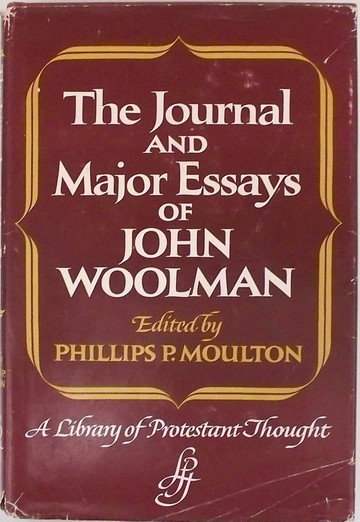
In my college years I became keenly sensitive to the social justice concerns that Christ demands of us. No writing helped me more than The Journal of John Woolman. It gives attention to some of the most pressing social issues of his day — and of ours: racism, consumerism, militarism, and more. Woolman was the single most important individual in bringing the Society of Friends (Quakers) to utterly reject human slavery, and to do so before the American Declaration of Independence was signed. For years Woolman had worked tirelessly with individuals over the slavery issue, but he knew this was not enough. For Quakers, the Philadelphia Yearly Meeting Sessions of 1758 became the great watershed on the slavery question. Woolman writes that leading up to this gathering he was “frequently covered with inward prayer, and I could say with David, ‘that tears were my meat day and night.” He sat through the meeting in total silence, head bowed and tears in his eyes, as different people debated the issue, pro and con. Finally, Woolman rose to his feet and delivered one of the great speeches in American religious history. “My mind,” he declared, “is often led to consider the purity of the Divine Being, and the justice of his judgments; and herein my soul is covered with awfulness.” He continued on, reminding those assembled that the cries of the slaves have “reached the ears of the Most High” and that now is “not a time for delay.”
To his compassionate appeal this great assembly responded, without spoken dissent, to remove slavery from her midst. Of this gathering John Greenleaf Whittier enthusiastically declared that it “must ever be regarded as one of the most important religious convocations in the history of the Christian Church.”
It is events like this that have caused John Woolman to teach me so very much about the social justice implications of discipleship to Jesus. I’m confident he will help you too.

Perhaps you are acquainted with several of Lewis’s writings, most notably Mere Christianity, The Problem of Pain, and perhaps The Chronicles of Narnia or his space trilogy. These are wonderful books to read and always instructive, but for our purpose of spiritual formation development we turn to The Screwtape Letters.
These imaginative letters from a senior devil (Screwtape) to a junior tempter (Wormwood, his nephew) are filled with moral and ascetic theology. It takes us only a few moments to understand that the insights into soul growth are always in reverse; instead of the ultimate goal being love, it is spiritual cannibalism, and so forth. It sets forth a rich psychology of temptation, but always from the opposite point of view. God is “the Enemy,” Satan is “our Father below.” Everything must smell and taste like hell. All experiences of freshness, beauty, and hope are eliminated. All that remains is cold, ruthless, and unsmiling.
I suggest that you have fun with this book. Enjoy the moral reversals. Play with them, considering other options to express hunger and fear and self-absorption. We can learn much from negative example. When dealing with pleasure as a tool for demonic temptation, Screwtape warns his young student, “Never forget that when we are dealing with any pleasure in its healthy and normal and satisfying form, we are, in a sense, on the Enemy’s ground. I know we have won many a soul through pleasure. All the same, it is His invention, not ours.”
As entertaining as it is, this is one book I suggest you not linger on for an extended period. Perpetual diabolical thoughts have a way of sucking the life out of a person. Lewis himself felt this in the writing, confessing that it “produced a sort of spiritual cramp. The work into which I had to project myself while I spoke through Screwtape was all dust, grit, thirst, and itch.”

For half a millennium, The Imitation has been the unchallenged devotional masterpiece for Christians everywhere. This simple book that distills the insights of a dynamic spiritual movement of the fifteenth century known as “The Brethren of the Common Life” — which was, in turn, an important expression of the Devotio Moderna (New Devotion) — has enriched us immensely.
So much of this book speaks to my condition. I especially like the third section (Book 3), which is couched in the form of a dialogue between the disciple and Jesus. (This is made expressly clear in the William Creasy translation.) Here is a small taste:
JESUS: “My dear friend, you are not yet a courageous and wise lover.”
DISCIPLE: “Why, Lord?”
JESUS: “Because at the least little hardship you drop what you are doing and you impatiently look around for a word of comfort from anyone who happens to be close at hand… As I please you in good times, so I shall not displease you in bad times. The wise lover does not consider so much the lover’s gift, as the giver’s love.”
Here is a counsel from à Kempis that is just right for our contemporary context: “We should read devout and simple books as willingly as we read those that are lofty and profound. Do not let the writer’s authority or learning influence you, be it little or great, but let the love of pure truth attract you to read.”
Section four (Book 4) focuses on the Eucharist and, as you would expect, à Kempis shares sentiments and convictions that are expressly Roman Catholic. If you understand this, we all — Catholic and Orthodox and Protestant alike — can benefit from tender expressions like these words of the disciple, “I thank you, good Jesus, eternal Shepherd, for choosing to nourish us with your precious Body and Blood and for inviting us by your own words to share in these mysteries, saying: ‘Come to me all you who labor and are burdened, and I shall refresh you.”
In summary, I am drawn to the words of Thomas De Quincey who speaks of the Imitation’s “slender rivulets of truth silently stealing away into light.”

To this day I vividly remember my first encounter with this slender book. I was at the Dulles International Airport preparing for a flight from DC to LA. And irrevocably Kelly drew me into the subterranean chambers of my soul. The cold rain splattering on the window outside matched the hot tears splattering on my jacket. I was never to be the same.
This book contains flashes of insight that have an uncanny ability to captivate our heart. Listen: “I find God never guides us into an intolerable scramble of panting feverishness.” Or this: “The pure in heart shall see God? More, they who see God shall cry out to become pure in heart, even as He is pure, with all the energy of their souls.” Kelly coined the term “the divine Center” and he concludes his book with a reference to this most unusual and original phrase; “Life from the Center is a life of unhurried peace and power. It is simple. It is serene. It is amazing. It is triumphant. It is radiant. It takes no time, but it occupies all our time. And it makes our life programs new and overcoming. We need not get frantic. He is at the helm. And when our little day is done we lie down quietly in peace, for all is well.”
In our day we have so few great saints and so few great writings of devotion that when we discover such a person and such a writing we will do well to treasure both.

This little book is a wonder and a masterpiece of the interior life. Its simplicity is stunning. Guyon herself says that she penned these words “to induce the whole world to love God and to serve Him in a way that is easier and simpler than any could imagine.”
Actually, this little book was written primarily for those who could not read for themselves and others were to read it to them. She speaks with great tenderness to the person who could not read: “You may feel you are unqualified to know the depths of your Lord. But in fact, you are really blessed. The blessing in not being able to read is that prayer may become your reading! Do you not know that the greatest book is Jesus Christ Himself? He is a Book who has been written on within and without. He will teach you all things. Read Him!”
We must not disregard this book because of its simplicity of style, for it is filled with a profound experience of God. Listen to her simple, experience-filled definition of prayer: “What is prayer? Prayer is a certain warmth of love. Ah, but more! Prayer is a melting! Prayer is a dissolving and an uplifting of the soul.” So, my friend, enjoy the ease by which Jeanne Guyon guides us into the “depths of Jesus Christ.”

With his Confessions, Augustine originated the paradigm for all future autobiography. It is filled with revealing personal stories, profound psychological insights, and complex philosophic reflections. He opens with his famous prayer to the Lord of all creation, “You made us for yourself, and our heart is restless until it find rest in you.” Augustine reveals fascinating aspects of his intellectual search — from Cicero who gave him an ardent love of wisdom; to Manichaeism, with its absolute dualism of good and evil; to “the Academics” who embraced agnosticism; to the Neo-Platonists who became a kind of pre-evangelism for Augustine; and finally to life in Christ and his power over “the whirlpools of vice” and the academic sins of pride and power and all “the arts of deception.”
On his intellectual journey Augustine is brutally honest about his inability to overcome “the swirling mists of lust.” As a student in Carthage he was thrust into “a hissing cauldron of lust.” It was during these years Augustine took to himself a concubine, and she bore them a son, Adeodatus.
Augustine found himself trapped in a contradiction: on the one hand searching for the good, the true, and the beautiful; on the other hand, finding himself a moral prisoner to “a whole frying-pan of wicked loves.” He confessed, “The enemy held my will and made a chain out of it and bound me with it. From a perverse will came lust, and slavery to lust became a habit, and the habit, being constantly yielded to, became a necessity.”
Outside of Scripture itself Augustine’s Confessions record what is arguably the most famous conversion story in the Christian canon. It occurs in a small garden in Milan —well, perhaps it is best for you to read what happens for yourself, along with everything that follows: “Take and read.”

Poustinia is a Russian word meaning “desert,” and Catherine from childhood received the piety of a distinctively Russian incarnation of the gospel. For me this book was a graceful introduction to the treasures of Russian Orthodox spirituality. A special feature of this spirituality is the construction of small cabin-like “Poustinias” where a person from the community, a Poustinik, can go for personal, silent retreat, usually for twenty-four hours. The Poustinia is described as the place “where heaven meets earth.” Those who enter these periodic retreats do so not just for themselves but also for the entire community, and they are to bring back to the community any word from God they receive while in retreat.
The Poustinia cabin itself is small and simple: a hard bed, a small table and chair, the Bible, and a plain cross. On my occasional trips to Great Britain I have visited Poustinias (though I have not taken retreat in them), and they are indeed simple in the extreme.
Silence and solitude are marks of the Poustinia. Catherine writes, “True silence is a garden enclosed, where alone the soul can meet its God. It is a sealed fountain that he alone can unseal to slacken the soul’s infinite thirst for him.” And again, “True silence is a key to the immense and flaming heart of God. It is the beginning of a divine courtship that will end only in the immense, creative, fruitful, loving silence of final union with the Beloved.”
Catherine also stresses the importance of “the poustinia of the heart.” She writes, “Deserts, silence, solitude. For a soul that realized the tremendous need of all three, opportunities present themselves in the midst of the congested trappings of all the world’s immense cities.”
Well, perhaps this will encourage you to learn more from Catherine Doherty and the communities that have sprung up around her teaching so that you too can “listen to God’s speech in his wondrous, terrible, gentle, loving, all-embracing silence.”

All of Willard’s writings in Christian spirituality are well worth the investment. I focus on Renovation for two reasons. First, it provides an exceedingly thoughtful analysis of the human person: spirit (heart/will), mind (thought/feelings), body, social context (interactions), and soul. In doing this, Willard is bringing to us his vast knowledge from his chosen field of philosophy in a way we can understand. Second, it provides us with the most thorough teaching on how the human personality is actually formed, conformed, and transformed into the image of Christ.
Two chapters particularly deserve attention. The first, entitled “Transforming the Soul,” takes head-on all the intellectual fads of today that attempt to deny the existence of the soul. Willard is well equipped to do this with his extensive knowledge of the biblical material as well as being a well-recognized expert in Plato’s Republic, a book he described as a work on the soul. The other chapter is “Spiritual Formation in the Local Congregation.” Here Willard provides wise and practical counsel for churches, large and small, to actually becoming “children of light.”
Explaining the central purpose for Renovation, Willard writes, “I have tried to gently ignore the many vessels of spiritual formation that litter the historical and contemporary landscapes and concentrate on the treasure: Jesus Christ himself, living with increasing fullness in every essential dimension of the personality of the individual devoted to him as Savior and Teacher.”
If you will allow a personal note: I knew and worked with Dallas Willard for forty-plus years and I can say without equivocation that the gentleness of soul and warmth of heart that people were drawn to in his teaching were matched by his daily life. Not perfectly, mind you, but substantially so.

The Interior Castle is the best and most thorough teaching on, and experience of, Christian prayer that I have ever come upon — not prayer as an occasional exercise, like a faucet that we can turn on and off at will, but prayer as the river of life in which we swim.
The Interior Castle positively dances with metaphor, or one extended metaphor really, picturing the soul as a crystal or diamond castle. This metaphor came to Teresa through prayer itself: “Today while beseeching our Lord to speak for me because I wasn’t able to think of anything to say … there came to my mind … our soul… like a castle made entirely out of a diamond or of very clear crystal, in which there are many rooms. …”
What is surprising about this image is the movement inward as Teresa guides us from the outermost rooms further and further in, room after room, until we arrive at the innermost regions of the “palace where the king lives.” This image of going deeper and deeper inward must have been a shock to the sixteenth-century mind-set, for their whole worldview was hierarchical — movement upward. But it is helpful for us to recognize that this movement inward shocks us too, since movement outward-doing, accomplishing, achieving — dominates our worldview. I imagine Teresa has much to teach us today about what it means to move inward.
Nothing quite compares to Teresa’s galvanizing, almost erotic description of communion with God. The soul is a paradise where the Lord says he finds his delight. The body is the outer walls of the castle. Self-knowledge is a room in this castle. In the final dwelling places, we come to the ultimate arrival of spiritual intimacy between God and ourselves — union. Here Teresa turns, as if inevitably, to the metaphor of marriage. Not marriage as a modest, domestic arrangement. Oh, no. This is marriage as the passionate union of the beloveds where “God carries off for Himself the entire soul, and, as to someone who is His own and His spouse.”
It has taken me many years to work my way through The Interior Castle. I never seemed to be able to take in too much at any one time. Sometimes, I felt like I was still standing out on the front porch. At other times, I no doubt have been wandering around in circles in some of the side halls. But, with patience and a whole lot of time, I did indeed begin to recognize a clear progression forward in the spiritual life.
The beauty of The Interior Castle is that you and I can call upon “His majesty” to help us, just as he helped Teresa. And the crystal palace of our soul will, in time and through experience, increasingly glow with the divine Presence.