
Fresh Forgiveness
LETTER BY BRIAN MORYKON
Ah, how can I talk about forgiveness in a fresh way, both for your sake and mine? I want to feel again its liberating weight.
We know the sayings, the quotes, the mottos…
Harboring unforgiveness is like drinking poison and expecting the other person to die.
Forgiveness sets two prisoners free.
We love that stuff.
We love it until someone crosses our line — hurts our kids, breaks our bank account, votes for the enemy.
We love it until we cross our own line, violate our own values, inflict something inexcusable.
Then we pause. Because forgiveness in those moments can feel not only impossible but immoral — an abortion of justice.
Here’s where a “Forgiveness 101” refresher may be helpful:
- Forgiveness does not condone nor eliminate consequences; it releases the need for revenge.
- Forgiveness does not replace justice. It is “among other things its precondition” (Keller) and “the Christian weapon of social redemption” (MLK).
- Forgiveness doesn’t forget nor minimize; it faces, grieves, releases.
- Forgiveness can be chosen but not rushed. It doesn’t replace anger; it prevents contempt.
Forgiveness can happen in a moment.
It can take years.
Often it’s both.
Forgiveness is an act of will. More specifically, it is an act of willingness.
It is a divine initiation met by a human choice and met again and completed by divine grace.
Forgiveness requires humility. If we’re forgiving someone else, we must hold in mind how large a debt God has forgiven us. If we are forgiving ourselves, we must move from the false humility of self-loathing to the true humility of repentance. We bow and confess without excuse, then lift our heads to meet the eyes of Christ on the cross. In those eyes we find the mercy we couldn’t give to ourselves.
Forgiveness is extreme.
A graying, long-bearded man stands in a courtroom. He is addressing the serial killer who murdered his daughter. His voice quivers, not from the hatred from which he has already been delivered, but from the pain of loss. He was preceded by others who lost their loved ones and gave the killer words he expected and deserved: “I hope you rot in hell.”
The old man speaks. “There are people here who hate you. I’m not one of them… You’ve made it difficult to live up to what I believe, and that is what God says to do, and that is forgive, and he doesn’t say to forgive just certain people, he says forgive all. So you are forgiven.” And at this, the stone-faced killer wept.
Was that the final act of forgiveness for the old man? Maybe, maybe not. The command of Jesus to forgive seventy times seven can apply to the same transgression. Some hurts need four hundred ninety layers of forgiveness before the bleeding stops.
Forgiveness is everyday.
On Tuesday, I needed to talk to one of my kids about something. Before the conversation, the Spirit alerted me to my anger and irritation, so I took a few minutes alone to name my feelings before God. I released forgiveness toward my kid and received forgiveness for myself where I felt I had failed. From that place of forgiving and standing forgiven, I was able to enter into a fruitful conversation because the air wasn’t poisoned with unacknowledged resentment.
Finally, forgiveness is essential.
Jesus names it in the Lord’s Prayer just after daily bread, perhaps to pair sustenance of the body with sustenance for the soul. In haunting words, he says that if we don’t forgive others, the Father won’t forgive us. God is the First Forgiver, of course. Christ is saying it is to our great detriment not to pay that forgiveness forward.
So, Lord, help us receive your forgiveness and release your forgiveness — for big wrongs, for small wrongs; for your sake, for our sake; for the sake of your Kingdom coming on earth as it is in heaven. Let your people everywhere be known — and you known through them — by the power of their forgiveness.

Brian Morykon
Director of Communications
P.S. Our 300th episode of Renovaré’s podcast Life With God is around the corner. Nathan Foster would love to answer some listener questions on air. For example, Have you ever felt intimidated by a guest or topic? What do you do to prepare? Ask your questions here.

Sign up for Renovaré Weekly
Thoughtfully introduced Christ-centered spiritual formation resources.

LET’S DIVE IN...
CURATED BY GRACE POUCH
-
1.
Nathan Foster writes, “Few words are more powerfully disarming than ‘I’m sorry.’ Few words are more liberating than ‘I forgive you.’”
-
2.
Tim Keller answers questions from co-author John Inazu on forgiveness in this 2020 interview.
-
3.
Christ-followers must learn to trade revenge for forgiveness, hate for love, and destructive power for creative power. Read “The Creative Power of Reconciliation”, from The Challege of the Disciplined Life by Richard Foster.

Grace Pouch
Content Manager
WORTH QUOTING
“Everyone says forgiveness is a lovely idea, until they have something to forgive…”
– C.S. Lewis
Mere Christianity
(source)
TO CONTEMPLATE
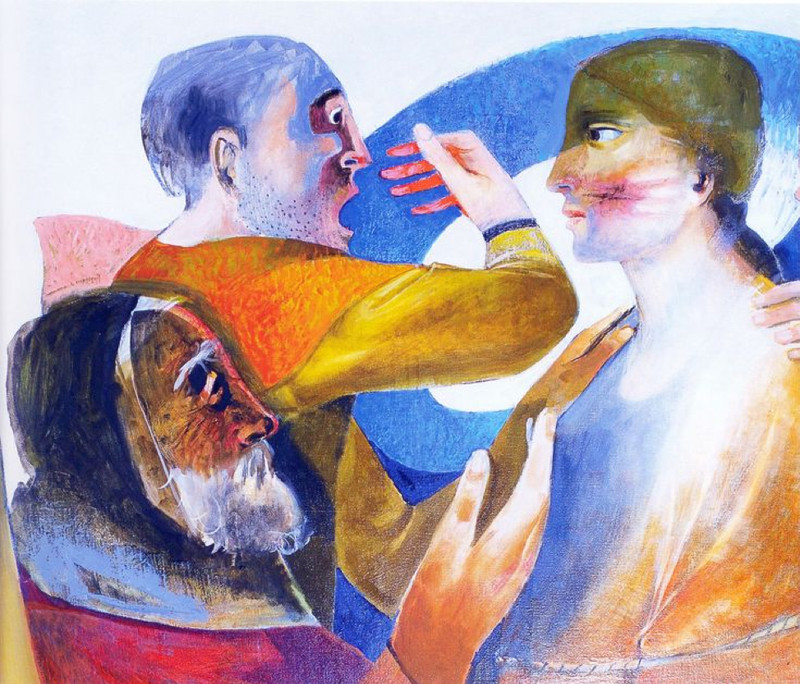
The Slap
Arcabas (Jean-Marie Pirot) 2003
(source)
Jesus didn’t just preach non-retaliation, he practiced it.
A kingdom person is learning from Jesus how to be unoffendable. As we grow to trust God’s eternal justice, our own belovedness, and the belovedness of others, we can be at peace and let others off the hook.
TO PONDER
Has someone offended you recently? Have you offended someone else? What is one step of forgiveness or repentance that you could make?