
Engaged Surrender
LETTER BY BRIAN MORYKON
No one on earth was more engaged than Jesus. And no one more surrendered.
No one loved more fiercely. And no one held those he loved more freely.
Jesus let people choose. We see it over and over in his earthly ministry. Think of John the beloved; think of Judas the betrayer. He loved them both, and all his disciples, and all those he met. In a real sense, he was attached to them — his heart was connected to them. Because of that love, he felt the cost of their choices. Yet because he was so rooted in the Father’s love, so attuned to the Father’s voice, he held them — and now holds us — with open hands.
Jesus is the model of healthy detachment and indifference. At first blush, these terms may sound apathetic or aloof. But in the light of the life of Jesus — and a little help from Jesus’ friends like Ignatius of Loyola — we discover that healthy detachment and indifference pulse with presence and vitality.
You see, when a situation is out of our control, or a person is beyond our help — or refuses the help we give — we often worry. Eventually, to alleviate the worry, we may give into resignation. But resignation is pseudo-surrender, an attempt to stop the internal bleeding of caring too much by pretending we don’t care at all.
Surrender is different. It is caring enough to actively give what we can’t control to God — with all the honest emotion that requires. “Cast your cares on God because he cares for you” (1 Peter 5). Casting is active. It is to throw at God those things that are too hot to hold, trusting that God is capable of catching and doing something with them.
So, through tears and as best we can, we give to God what burdens us. But how do we care for people without controlling them? We listen. This is also more active than it sounds. Not “active” in the sense of preparing what we’ll say next or figuring out a solution, but active in the sense of being fully present.
I’m in a class at my church on trauma care, led by a couple who have spent decades doing mission work in Ukraine. The war there has inflicted massive physical and physiological wounds. What does this couple do first when they spend time with people whose neighborhoods are reduced to rubble? They listen. They ask open-ended questions. In time, and as far as they can, they also help find solutions. But first, they listen. Because healing begins with being heard.
This is the way of Jesus — engaged surrender, presence with people, listening to the Father for how to respond in light of our limitations, and continually unfurling our fists from holding things we can’t control.
So, Father, teach us what your friend John Eldredge calls “benevolent detachment.” We want to be both engaged and surrendered, like Jesus. Teach us how to listen. Help us discern what is within the realm of our responsibility — those areas where we cooperate with you in making a difference — and what matters are, as David said, “too great and difficult for me.” Amen.

Brian Morykon
Director of Communications

Sign up for Renovaré Weekly
Thoughtfully introduced Christ-centered spiritual formation resources.

LET’S DIVE IN...
CURATED BY MELODY LEEPER
Let’s Dive In this week was curated by Melody Leeper, Renovaré’s Community Life Program Manager.
-
1.
On Life with God, Renovaré’s Education Program Coordinator Wendy Dean and host Nathan Foster had a beautiful conversation about wanting what’s best for our kids and loved ones — and letting God’s vision of the best supersede our own.
-
2.
Ignatius of Loyola used the term “indifference” to mean accepting God’s wisdom as greater than our own and letting go of what doesn’t help us love God or others.
-
3.
I (Melody Leeper) talked with Adam Ormord on The Being Formed Podcast about the beauty of how Renovaré’s Listening Groups help us listen to others without trying to control or “fix” them.
-
4.
At every Renovaré Listening Group meeting, we repeat a commitment to care for others in the group without controlling them: We value people as God’s image bearers. In our interactions we resist the temptation to manage impressions, leverage relationships, and fix one another. Learn more about Listening Groups and sign up to drop in for one here.
-
5.
“More than any other single discipline, fasting reveals the things that control us.” Richard Foster looks at a spiritual practice designed to uncover our attachments and release us from their grip.
-
6.
Mark Scandrette writes on overcoming “close-handed anxiety” and stepping into Jesus’ teaching “Do not worry about your life.”

Melody Leeper
WORTH QUOTING
“Hold everything in your hands lightly, otherwise it hurts when God pries your fingers open.”
– Corrie Ten Boom
TO CONTEMPLATE
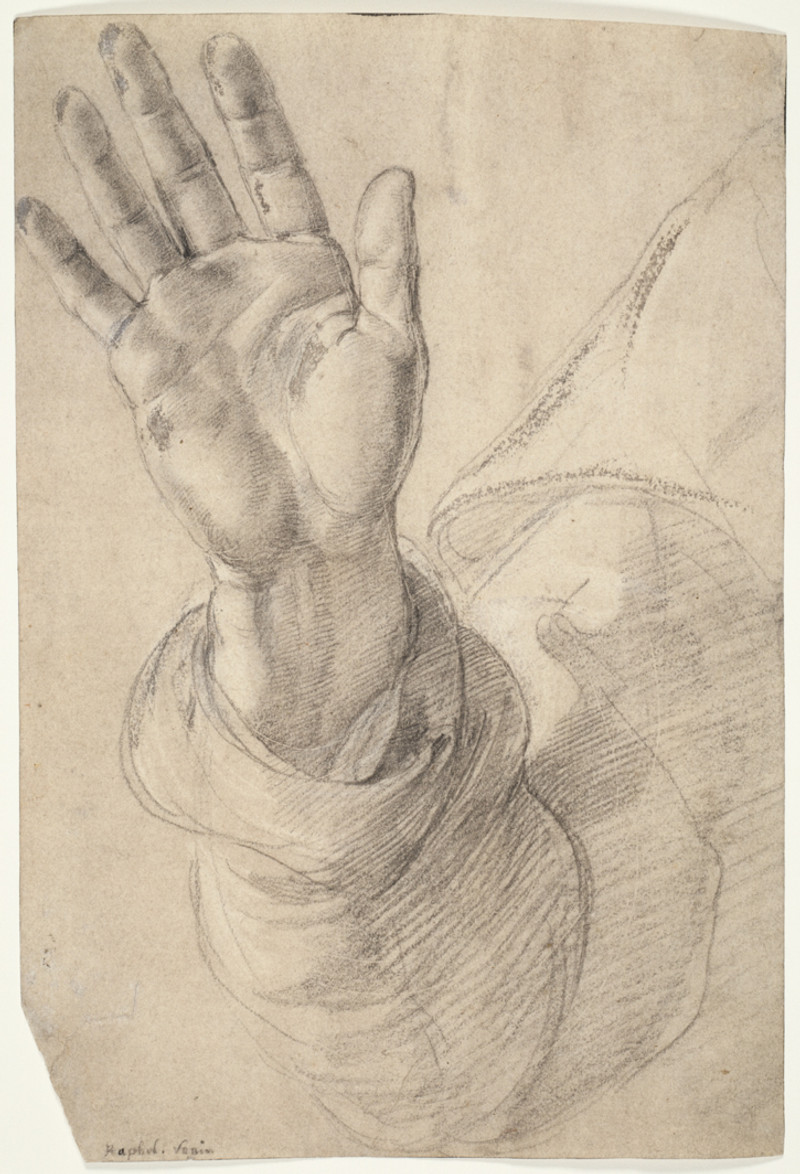
Upraised Right Hand: Study for Saint Peter
Raphael c. 1518
(source)
Gestures and facial expressions often communicate inner feelings (whether we realize it or not!). But when we purposely make our body take on a posture that signifies something we don’t feel, it can actually help our hearts and minds shift out of an emotion we are stuck in.
If you’re feeling stuck in a mindset of controlling outcomes, try “throwing up your hands” and relaxing your breathing while asking God to help you release the person or situation.
TO PONDER
Today when you notice the desire to control a person or situation, try praying this prayer by St. Ignatius:
Take, Lord, and receive all my liberty,
my memory, my understanding,
and my entire will,
All I have and call my own.
You have given all to me.
To you, Lord, I return it.
Everything is yours; do with it what you will.
Give me only your love and your grace,
that is enough for me.