
Kintsugi Kingdom
LETTER BY GRACE POUCH
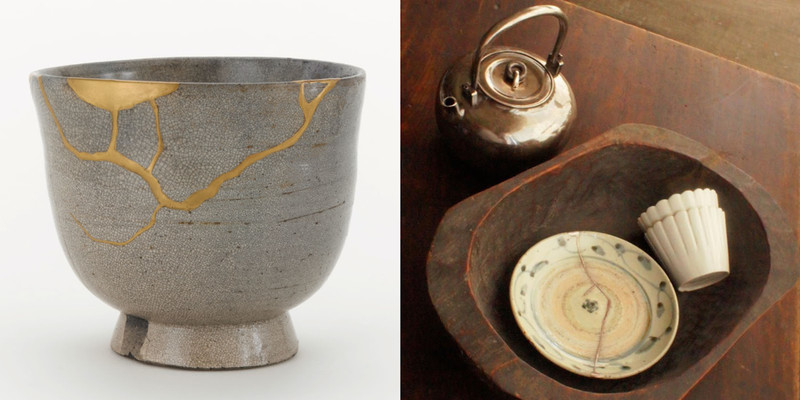
Most pictures of kintsugi are museum-like. A piece of pottery with lightning streaks of gold leaf sits on a sterile background. Displayed this way, as an artifact, we marvel at the artisty of a kintsugi vessel.
But I’m more drawn to the second image above. It shows a repaired plate, ordinary in appearance, back in circulation with the cups and tea kettle, set out for someone to use. Of course cups and plates and vases are mostly made to be useful. But when I see kintsugi displayed like sculpture apart from its original context, I forget that it had a function before it was broken. Now that it’s repaired, is it “just” art?
There’s nothing wrong with kintsugi-as-art. It’s beautiful. (My son and I are working on repairing a vase that fell victim to a raucous game of tag, and I plan to display it on a shelf.)
But as a symbol of repair in human lives, I prefer the down-to-earth image on the right. The plate is restored not just in form, but in function. Up on a pedestal isn’t where we belong. God mends us for something — for everyday practical use, in fact.
God’s an Artist, to be sure. His ability to repair our deepest cracks and wounds is worthy of wonder. But as much as our mended lives testify to his skill, he has even more in mind for us than display. His ultimate aim in human history is to take all his broken people and repair us for loving communion with himself and others. We are to be his partners in setting things right in the world … co-artists in his “kintsugi kingdom,” as Katelyn Dixon calls it.
God repairs us so that we can abide with him and reclaim our unique purpose in the world.
Spiritual restoration isn’t about optics or even perfecting our quirks. It’s about healing the things that hold us back from love.
When we welcome the Spirit’s renewal, we are made into practical art of the highest quality, with no limit to the lowliness and breadth of its service at his table.
Mend us with your artist’s eye and steady hand, and conform us to your pattern, Jesus. Restore us to the joy of your way of life — a life of practical love and lowly service to one another. Amen.

Grace Pouch
Content Manager
P.S. The Renovaré Book Club begins Monday! There’s still time to join this four book journey of renewal.

Sign up for Renovaré Weekly
Thoughtfully introduced Christ-centered spiritual formation resources.

LET’S DIVE IN...
CURATED BY GRACE POUCH
-
1.
Renovaré has just opened registration for a new virtual workshop, Kintsugi Kingdom: Spiritual Practices for Mending Divisions Within and Around Us. Join us to explore some of the practical ways God invites us to face brokenness, welcome his grace, and become instruments of his peace in the world.
-
2.
Steve Macchia joined Nathan on the Life with God podcast to talk about the gift of brokenness.
-
3.
“Confession is the spiritual discipline,” writes Richard Foster, “that allows us to enter into the grace and mercy of God in such a way that we experience forgiveness and healing for the sins and sorrows of the past.”
-
4.
In The Unhiding of Elijah Campbell—a new fiction book from IVP’s Formatio line — the main character experiences a rift in his life that can only be healed by facing old wounds and mending his relationship with God. You can read the first chapter on the author’s website.
-
5.
Peter Mommsen at Plough looks at “the quickening replacement cycle” of buying new things, rather than repairing them, as a habit that can weaken our appetites for other forms of redemption.
-
6.
In the film The Mission, slave-dealer Roderigo Mendoza (Robert DeNiro) seeks to make amends for his life of greed and violence by joining a community of Jesuit missionaries in the Paraguayan jungle. Roderigo’s personal journey to accept God’s forgiveness unlocks his ability to grow as a person of love and reconciliation in this community. When slave hunters raid the area, Roderigo and Father Gabriel (Jeremy Irons) disagree about how to protect the native villagers. The film dives headlong into broken systems and complex ethical questions — what to make of historical missions efforts that were entangled with national and economic ambitions, how to respond to the presence of both authentic and inauthentic leaders in the Church, and whether or not weaponized warfare is an acceptable means for achieving shalom.
WORTH QUOTING
“My life is like a broken bowl.
A broken bowl that cannot hold
One drop of water for my soul
Or cordial in the searching cold;
Cast in the fire the perish’d thing;
Melt and remould it, till it be
A royal cup for Him, my King:
O Jesus, drink of me.”
– Christina Rossetti
From “A Better Resurrection”
TO CONTEMPLATE

Mending the Sail
Joaquín Sorolla 1896
(source)
Mending is a process that permeates our lives (maybe less so these days, now that we’ve been trained to throw out and buy new). Think of some ways you participate in repair — taping a book cover, oiling the rusted latch, patching a tear in a shirt — or patching up a relationship, saying sorry, offering a handshake or a hug. Let these images grow in your mind as you lean into the invitation to be a person of reconciliation and repair.
TO PONDER
What is one crack in your character or one wound that holds you back from love? Ask God to help you see a next step toward welcoming his repair-work in your life.