

If you’ve been around Christians for any length of time, you’ll have heard someone say, quite matter-of-factly, “Oh, God told me this,” or, “The Lord said that,” as if it’s the most normal thing in the world. But just try using that line with your General Practitioner: “Doctor, I’m hearing the voice of Jesus.” Or in a court of law: “God told me to do it, Your Honor.” They’ll medicate you or detain you before you can shout, “Hallelujah!”
And yet, many of the most eminent people who have ever lived have freely admitted to hearing the voice of God, from George Washington Carver, sometimes called the African American father of modern agriculture, to Florence Nightingale, the mother of modern nursing who wrote in her diary, shortly before her seventeenth birthday, “God spoke to me and called me to his service. What form this service was to take, the voice did not make clear.” From Ben Carson, the pioneering American neurosurgeon and former presidential candidate who felt called into medicine through a supernatural dream, to Dag Hammarskjöld, the Swedish economist who won the Nobel Peace Prize and was described by John F. Kennedy as “the greatest statesman of our century”. From the genius French polymath Blaise Pascal, to the escaped slave and trailblazing abolitionist Harriet Tubman. From the Scottish Olympian Eric Liddell, who famously felt God’s pleasure when he ran, to the blind English poet John Milton, who dictated to his daughter each morning whatever he had heard from God the night before.
Survey after survey confirms that most people in our supposedly secular Western societies still interact with God. We don’t approach chemotherapy thinking, “I suppose I ought to pray about this, but I just can’t be bothered.” We tend not to welcome newborn babies into the world with the words, “Behold, a biological fluke born into a meaningless universe.” No one ever stared up at a murmuration of starlings at dusk, or out to sea under a stormy sunset, and whispered, “Wow, I’m awestruck by my own magnificence.” Human beings are hard-wired to worship. You have been meticulously made with an extraordinary ability to walk and talk with God. In fact, the Bible says that your primary purpose — the reason for which you were born — is to enjoy a real, conversational relationship with an infinitely loving divinity — which is why you almost certainly hear him already, more than you realize.
Your Father in heaven invites you to walk with him in a relaxed daily conversation as Adam and Eve did in the glades of Eden (Gen. 3:8). He wants to talk with you intimately as he did with Moses, “face to face, as one speaks to a friend” (Exod. 33:11). Occasionally he will communicate thrillingly through dreams, visions and audible voices, as he did with the apostle Peter on the rooftop in Joppa (Acts 10:9 – 19). But mostly he will speak quietly in “a still small voice” as he did with Elijah on Mount Carmel (1 Kgs 19:12), sounding surprisingly ordinary as he did when the boy Samuel confused his voice for that of the old man in the room next door (1 Sam. 3). Again and again the Lord will join you on your journey through life, stirring your soul and speaking through the Scriptures, as he did with the couple on the road to Emmaus.
Sojourner Truth
The nineteenth-century abolitionist and women’s rights activist Sojourner Truth could not read the Bible for herself, and yet she encountered Christ and heard his voice in ways that changed not just her own life but also those of countless others ever since. To date she has given her name to a library, a NASA space Rover, a US Naval ship and an asteroid. She has featured on a US postage stamp and a Google Doodle, in a Broadway musical and a sculpture that stands in the US Capitol Building in Washington, DC. She is honoured in the calendar of saints by the Episcopal Church, and in the list of 100 Most Significant Americans of All Time by the Smithsonian Institution. There are plans to make her the first woman of color to be featured on a US banknote since Pocahontas in the 1860s. Not bad for an illiterate woman, born into slavery in south-eastern New York in 1797, as one of ten (or perhaps twelve) children.
As a child, Isabella (as she was originally known) was bought and sold several times. At the age of thirteen she became the “property” of a cruel rapist called John Dumont. After seventeen years she escaped and found sanctuary with a godly Quaker couple who paid for her freedom. Isabella could neither read nor write, so the Bible was a closed book unless someone read it aloud. But then one day she received a vision: “A friend appeared… beaming with the beauty of holiness and radiant with love”. Recalling this epiphany while dictating her autobiography, Sojourner smiled: “I jes’ walked round an’ round in a dream. Jesus loved me! I knowed it, I felt it.”
This was the defining moment of her life. She asked God for a new name to reflect her new life and he gave her the name Sojourner “because I was to travel up an’ down the land, showin’ the people their sins, an’ bein’ a sign unto them”, and Truth “because I was to declare the truth to the people”.
And so it was that Sojourner Truth began traveling the land renouncing slavery and championing the emancipation of women. She was often threatened, sometimes attacked, and on one occasion beaten so badly she had to walk with a cane for the rest of her life. But she never backed down. “The Lord has made me a sign unto this nation,” she said, “an’ I go round a’testifyin’ an’ showin’ on ’em their sins agin my people.”
Her most famous speech — “Ain’t I a Woman?” — was delivered at a Women’s Rights Convention in 1851:
Look at me! Look at my arm. I have plowed, I have planted, and I have gathered into barns. And no man could head me. And ain’t I a woman? I could work as much and eat as much as man – when I could get it – and bear the lash as well! And ain’t I a woman? I have borne children and seen most of them sold into slavery, and when I cried out with a mother’s grief, none but Jesus heard me. And ain’t I a woman?
Quite rightly, the world today applauds Sojourner’s defiant and determined stand for freedom, but some would prefer to forget her motivation. The defining moments in her trailblazing life were encounters with the Lord Jesus Christ. First, he appeared to assure her of his love – and by this she found a fierce confidence. Next, he spoke to give her a new name – and by this she found her call. Ultimately, he spoke not just to her, but also through her as “a sign unto this nation … showin’ on ’em their sins”.
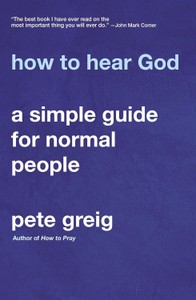
Extracted and adapted from How to Hear God: A Simple Guide for Normal People by Pete Greig (Zondervan Reflective, 2022).
Artwork: Thistles by John Singer Sargent, c.1883 - c.1884. Public domain.
First Published March 2022 · Last Featured on Renovare.org January 2026

Pete Greig
Pete Greig is a best-selling author, pastor and founder of the 24 – 7 Prayer movement which has reached more than half the nations on earth. He is also the Senior Pastor of Emmaus Rd, Guildford, England, an Ambassador for the NGO Tearfund, and teaches at St Mellitus Theological College in London. For 7 years Pete served with the senior leadership team at HTB and Alpha International. Pete’s publications include ‘Red Moon Rising’, ‘God on Mute’, ‘The Prayer Course’, and ‘Dirty Glory’. He loves art galleries, live music and knocking down walls. He tweets regularly @petegreig.

Get spiritual formation articles like this each Friday
Renovaré Weekly is our thoughtful free newsletter with curated articles, books, and upcoming free webinars.
Explore More
-
 EpisodeAudio Meditation: A Litany of Humility
 Nathan FosterExplore
 -
 EpisodeRoy Searle – The Heart’s Cry
Nathan Foster & Roy SearleExplore
EpisodeRoy Searle – The Heart’s Cry
Nathan Foster & Roy SearleExplore -
ArticleThe Patrick Compline
 Northumbria CommunityExplore
 -
EpisodeGod’s Voice, Avoiding Judgmentalism, & Children’s Deep Formation
 James Catford, Richella Parham & Grace PouchExplore


